
The premise of ‘Radical Change’ – that the radical idealism of youth morphs into conformity later in life, as you become part of the very establishment you once railed so fiercely against, is a very true and interesting one, applicable today as well as in the past, where this play is partly set, in order to give that comparison across one life.
The life being that of Karl, played by the talented Jake James Harrison, who we first see in a down-at-heel bedsit somewhere in London, playing The Clash very loudly and swigging beer as he plots the revolution. Although set in 1988, this scene for me has vibes of a decade earlier, the era of punk rock, the winter of discontent and the Cold War. In comes Karl’s neighbour Elizabeth, to complain about the noise, and in return for a few days’ peace, she allows herself to be regaled by Karl’s beliefs and vision for the future. An intelligent woman, Elizabeth has her own ideas, which form a comic foil to Karl’s somewhat naïve exposition.

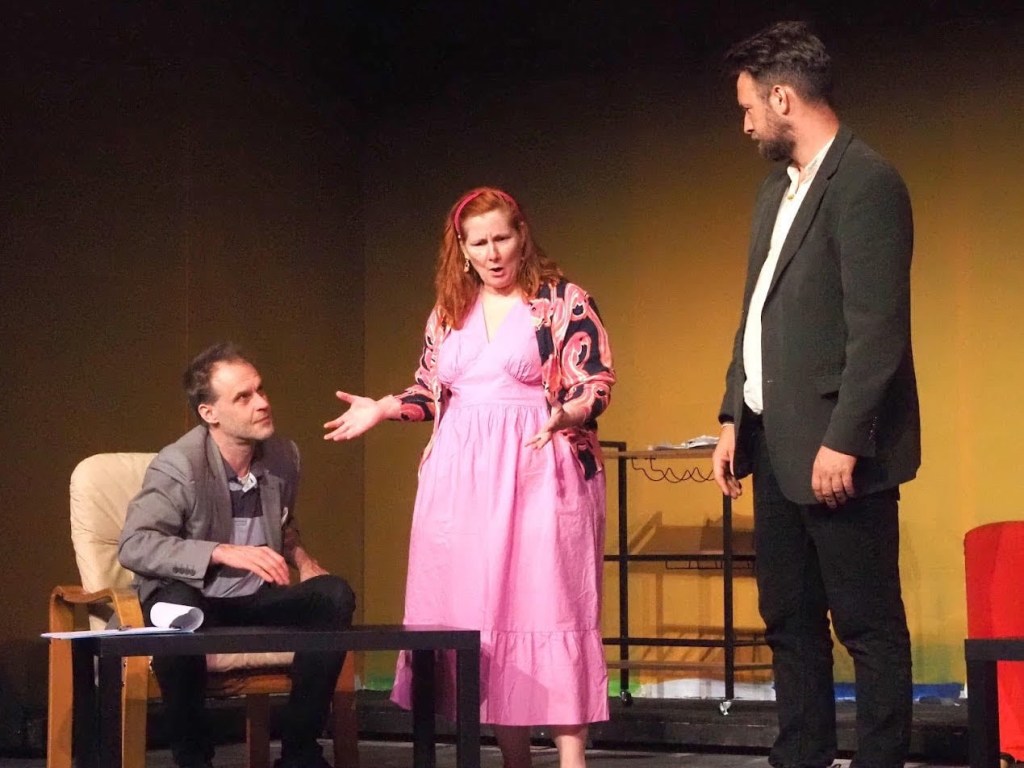
Donna Thornal gives Elizabeth Sloane Ranger- style ambiance, underpinned by her outfit – very 1980’s. The costumes indeed support the characterisation, with Karl’s ‘Che’ logo replaced by a sober suit in the second half, and Elizabeth’s 80’s style moving to a more contemporary look to indicate the passing of time between acts. The set too is cleverly constructed, with the structure displaying the grungy walls of Karl’s bedsit turning to become a London street scene and later the walls of an upper middle class sitting room.
Indeed, in the second half it is all change, as we meet the couple in their 50’s and discover our ‘working class hero’ is now the CEO of a large company, as fully wedded to the capitalist economy as he was to the Marxist ideology of his youth. So what has happened to change him? This is an area which, while questioned, is never actually discussed fully. While I can see the audience may be invited to fill in the gaps, a few hints and possibilities would support the plot further I feel. The parallels we see are constructed to underpin the changes – with Karl sipping wine rather than beer and complaining about the volume of a neighbour’s music.
The two central characters, who must be congratulated for the sheer amount of script they had to learn, are supported by Mark Duffus as Henry, who has his own life change, morphing from a police officer who apparently routinely beats up ‘commie bastards’ into an activist protesting about the planned closure of a local hospital. Vicki Cook makes the most of her cameo appearance as a police officer at the end – and the ending makes a good point, though it would be a plot spoiler to reveal it.
The actors and director, Gwen Stevens, have clearly worked hard on this play, and with some editing to eradicate some repetition in the dialogue which affected the pace of the action in places, the play has the potential to make a valuable commentary on life choices which is still relevant today.

 IWtheatre