
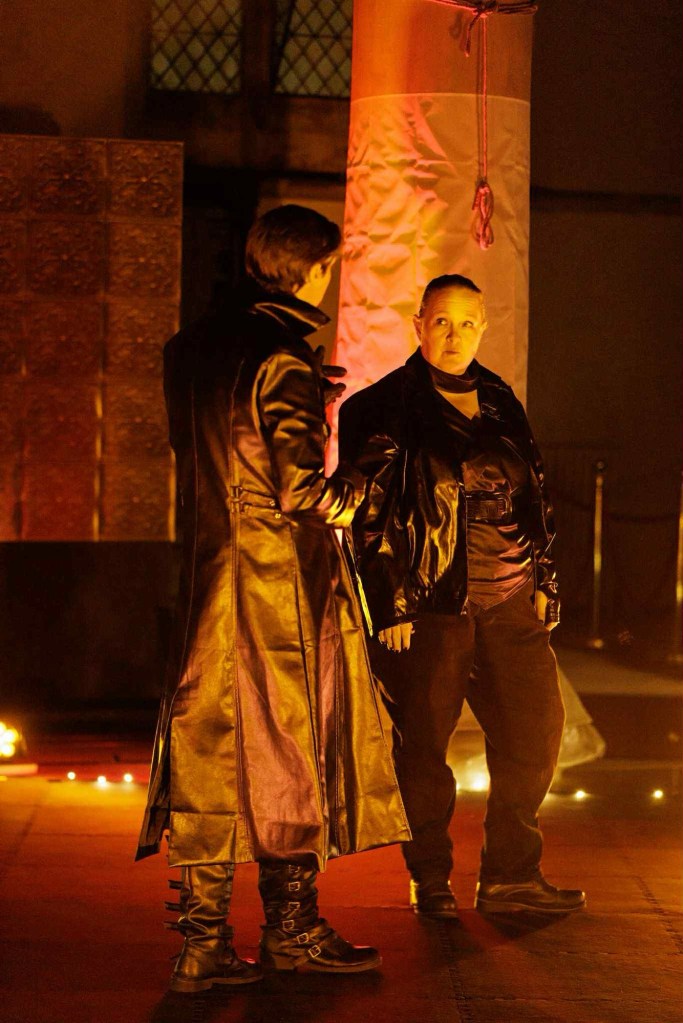
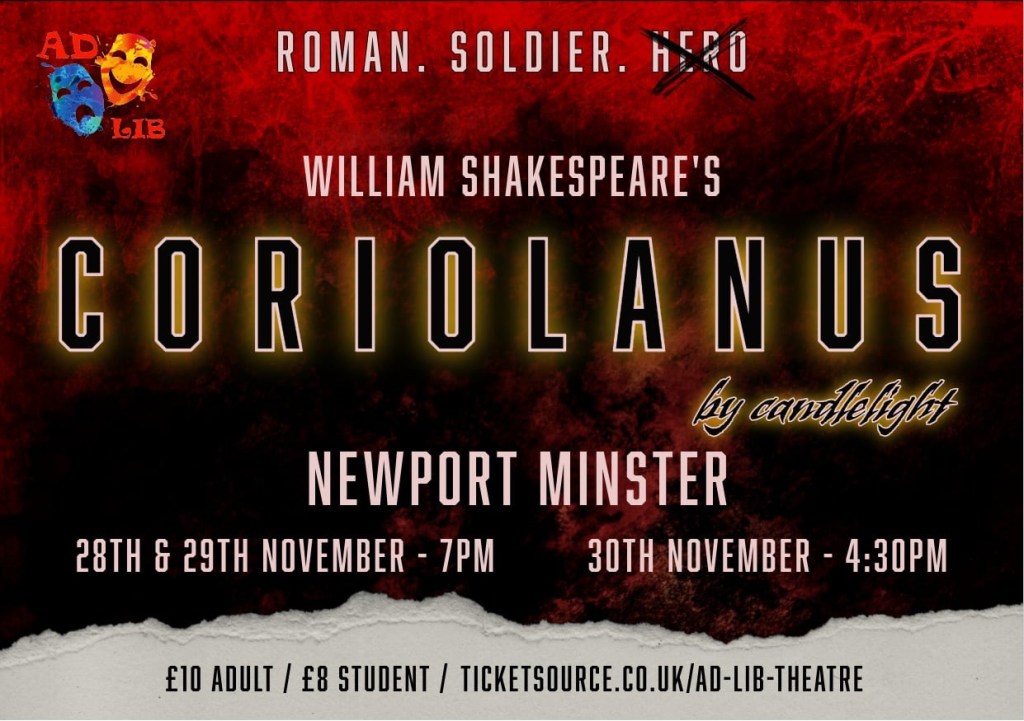
The walls of Newport Minster flickered and glowed with mellow and playful candlelight. In this majestic setting, with a floor adorned by candles of various shapes and sizes and large cylindrical columns bound with roped restraints; we knew that what we were about to see would not only be powerful but also would reverberate with the weight of a story told over the ages. Having settled everyone into their seats, we began to peruse the programme and were eager to see if, as Si Lynch promised, we would see a Rome that was ‘raw, proud and alive by candlelight’.
Coriolanus is one of Shakespeare’s most political plays; it explores the interplay between the power of the republic and the rebellion against the ruling classes. It is indeed a tragedy but one of multiple layers; a political tragedy, a personal tragedy and also a family tragedy; all interwoven in one story. The namesake main character Coriolanus, is complex one and in clear internal conflict throughout the play fighting between personal desire, civic duty, the draw of the battle-field and a biting distaste for the plebeian oversight of the masses.
At the start of the play we were gifted a distinct insight into Caius Martius’ (soon to be Coriolanus’) disdain for the common citizens as they rebel against the ruling class who are hoarding grain. Further corrective action towards these folk is averted due to the news that Caius Martius is needed to attend the battlefield and repel the forces of the Volscians who threaten the rule of Rome. The military leader excels in the fight so much so he is renamed Coriolanus for the valour and courage he has shown. However, this is a forced and begrudging honour for the soldier as he now becomes wrapped in the system of public power that he so despises.
It is this republic system, Coriolanus’ engrained pride and the opportunistic treachery of the Tribunes (Brutus and Sicinius), that will lead him on a journey of banishment, revenge and eventual demise. Coriolanus’s trajectory on this path is aided by a series of other characters who cajole and encourage him to ensure that their own desires might be fulfilled. The senators try to quell his noble pride in the face of the public outcry, his mother Volumnia pushes, prods and manipulates to feed her thirst for increased status and reputation. In addition, the aforementioned Tribunes exploit, twist and enrage such fire within the people that the embittered and banished Coriolanus is forced to turn towards his nemesis, Tullus Aufidius, the previously defeated leader of the Volscians.
The tryst between these two imposing characters is intriguing and explores a complex multilayered relationship moving from one of intense rivalry and mutual respect to one of a deeply personal and almost obsessive adoration. It is, as with all Shakespearean tragedies, that we indeed witness the catastrophic downfall of the central character. Following a last minute interjection from both his narcissistic mother and his devoted wife, Coriolanus halts the impending vengeful Volscian attack on Rome to barter a hurried negotiated peace with Aufidius. The Volscian leader, enraged by this perceived betrayal, arranges for the summary execution of Coriolanus. A bloody and harrowing end awaits for this fallen hero.
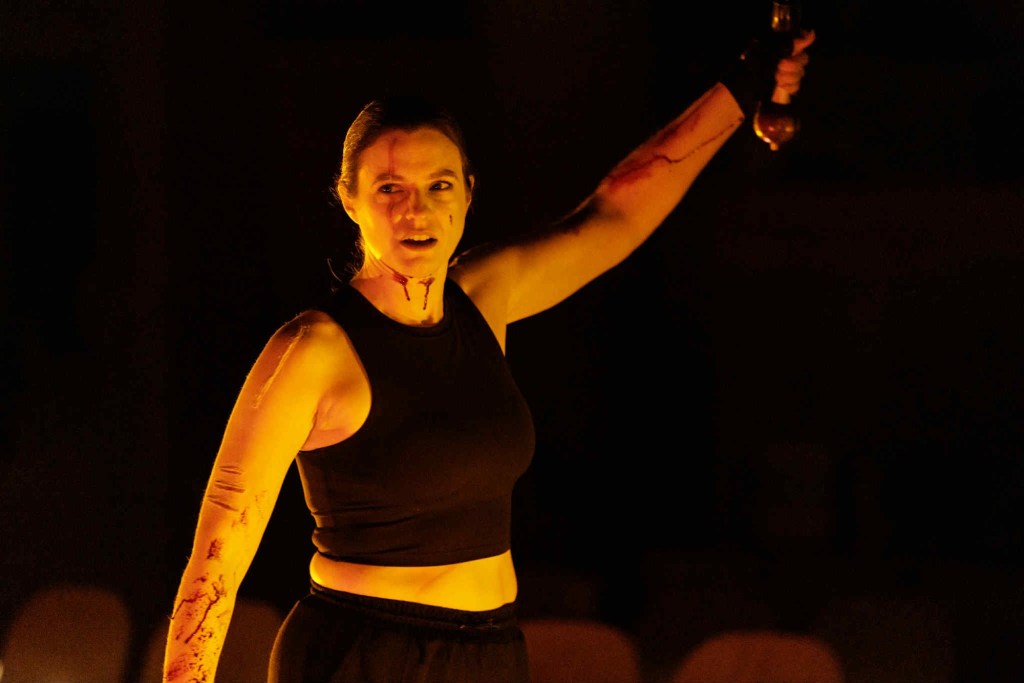
In the leading role Emily Scotcher excels. She commands the performance space with ease and, as no stranger to the writings of the bard, she extols the words with expert timing and thoughtful poise. This is a very strong and passionate embodiment of Coriolanus, showcasing both his strengths and flaws. Particular highlights for these reviewers were during her public approval as Consul, where she addresses the audience as members of the masses. She makes Coriolanus’ objection to popular rule so frightfully apparent. Emily’s ability to produce believable and skillful stage combat was also once again on show and added another impactful layer to the production. But it was indeed the final scene and Coriolanus’ eventual demise that impressed these reviewers most. The never faltering pride, passion and strength remained with Emily’s character to the very bitter end.
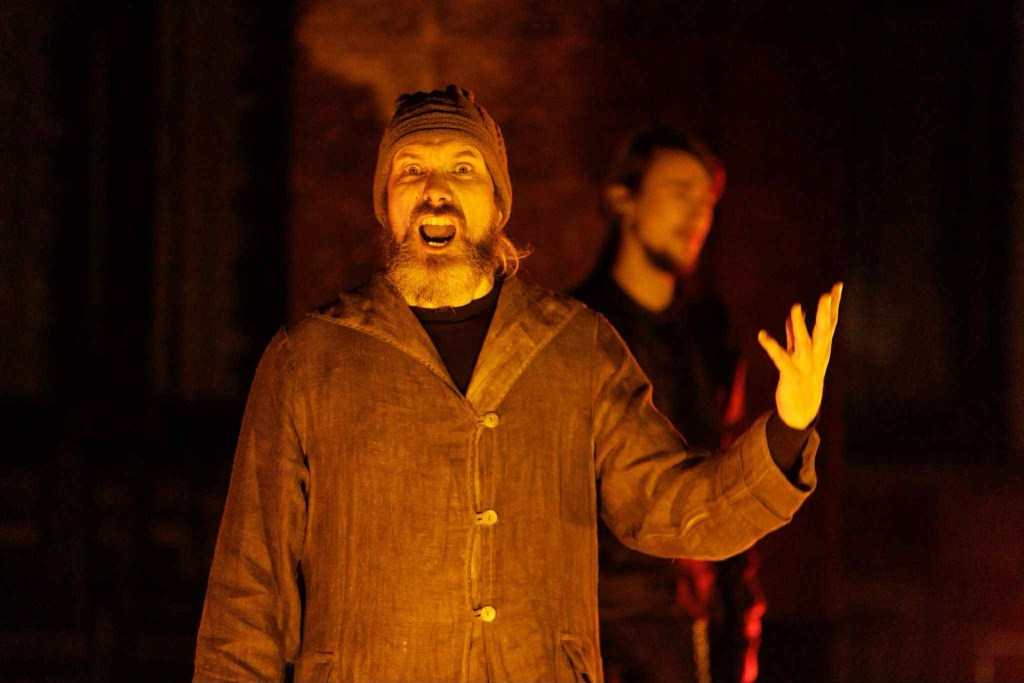
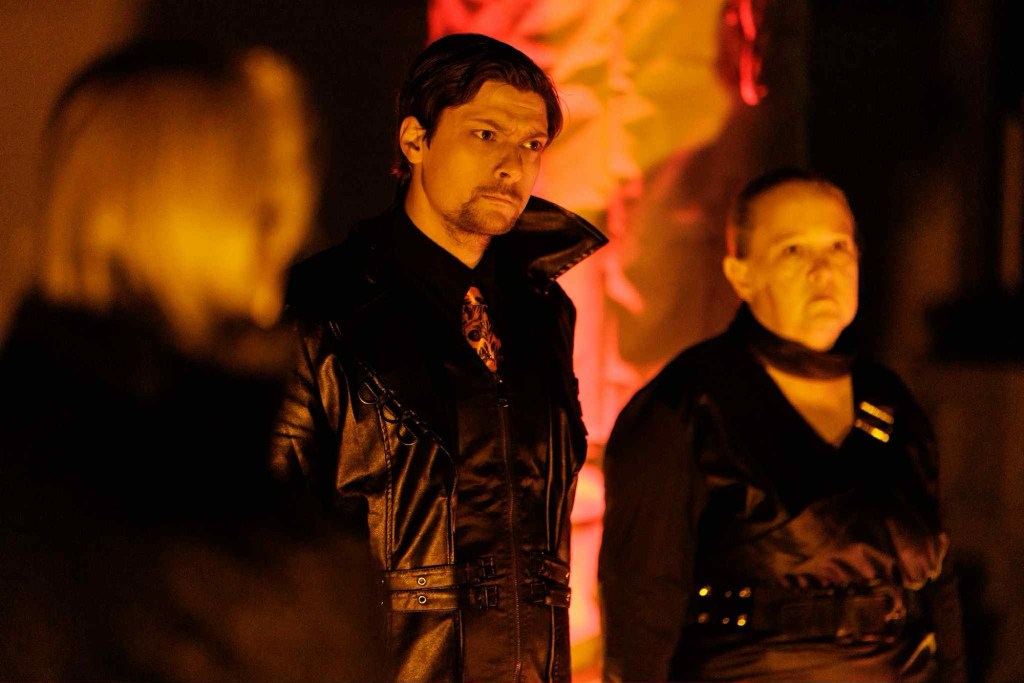
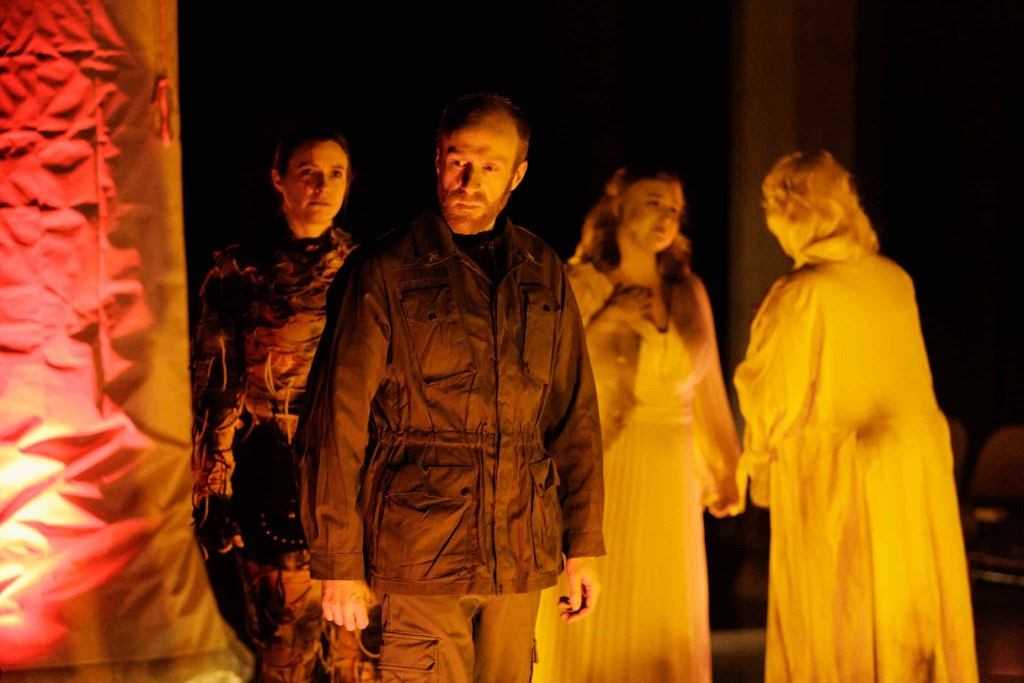
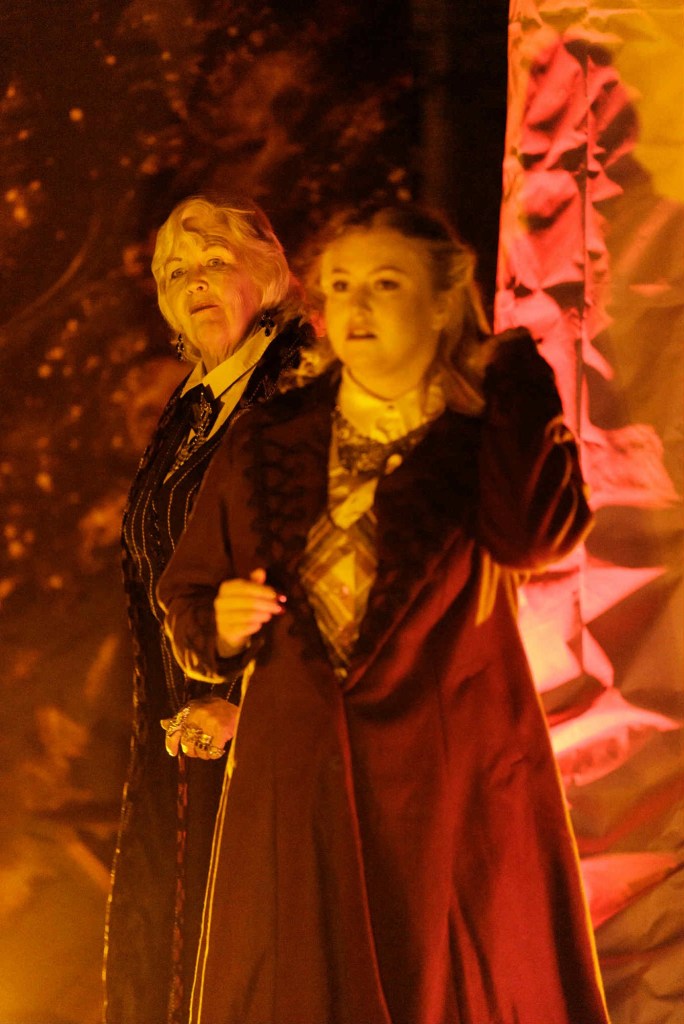

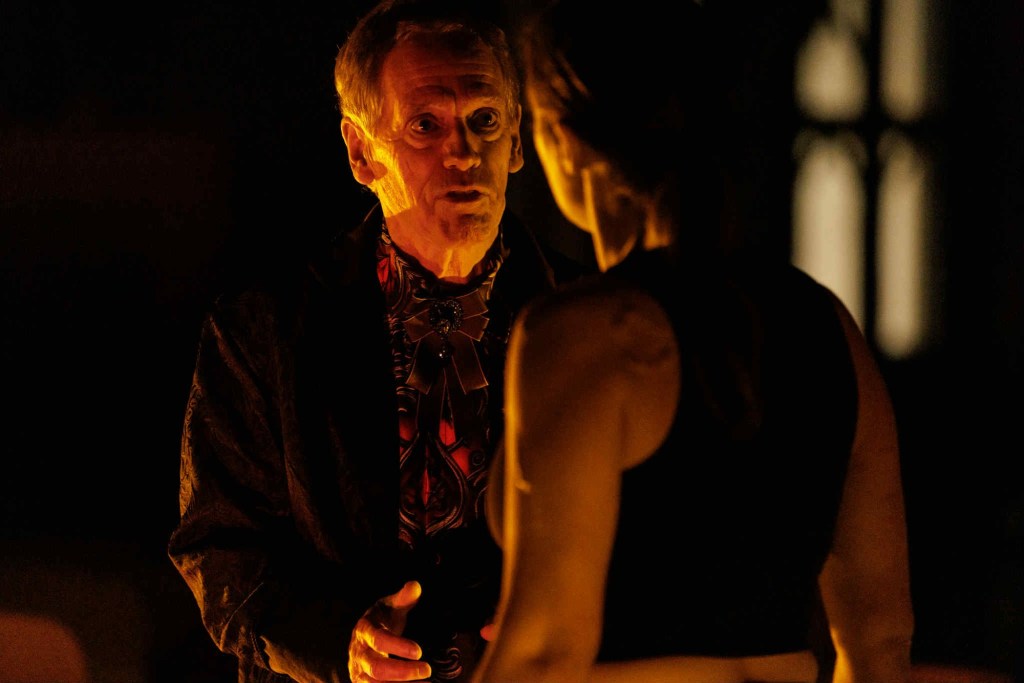

Menenius, played by David Stradling, bore all of the characteristics of a doting father, protector and mediator who desperately tries to balance both the fate of Coriolanus and Rome on his own shoulders. David provided a calm and engaging performance which conjured echoes of Patrick Stewart as Enobarbus in Anthony and Cleopatra.
Coriolanus’ other main ‘adviser’, albeit a very self-interested one, was his mother Volumnia played by Maureen Sullivan. Having raised her son to be a warrior, she revels in his success and in turn gleefully endeavours to exploit his deeds to further her desire for his political ascension. It is with exquisite timing and a playful calculating tone that Maureen engages Coriolanus to ultimately do her bidding. We indeed see this woven domination come to deadly fruition at the conclusion of the play when Volumina desperately convinces her son to abandon his partnership with Aufidius and broker peace eventually leading to his horrific death.
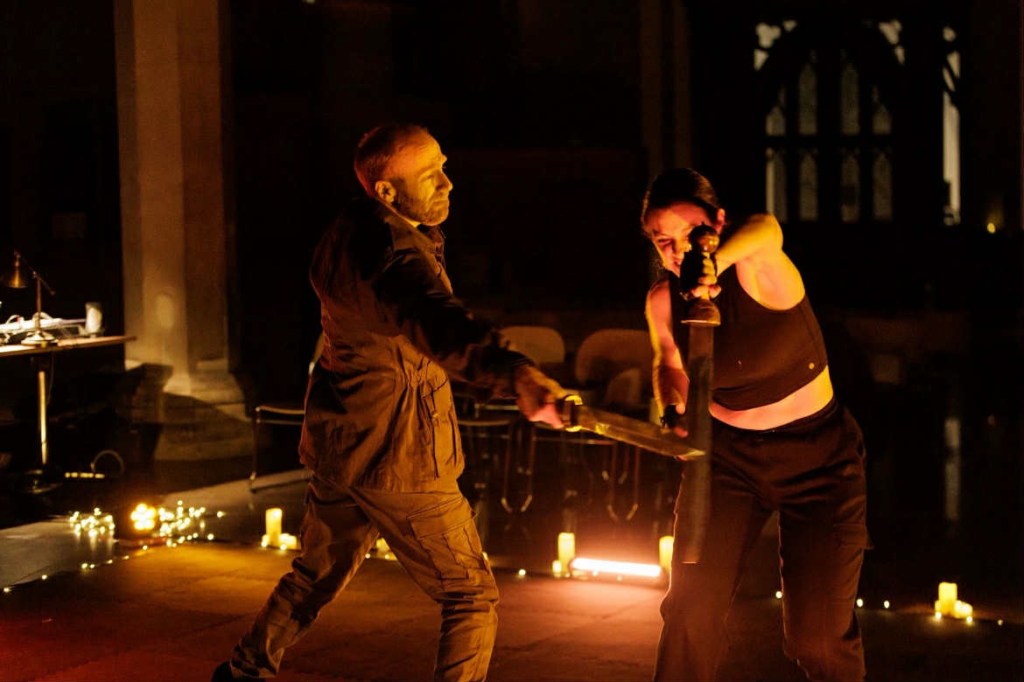
The battle worn and self-deflated Volscian leader Aufidius, is aptly played by the ever versatile Andy Kay. Whether a Russian businessman or king of the seas, he always delivers an authentic and skillful performance. In this production Andy gives a robust and powerful version of his character; we really feel his utter rage and pain when he is betrayed by the recently allied Coriolanus. Andy not only employs wonderful characterisation throughout but also expertly engaged in a series of well choreographed fight sequences.
As the Tribunes, Sicinius and Brutus, Fiona Boyle and Philip Barker managed to deliver a powerful insight to the transitional nature of the Roman republic. With the freshly installed office of the Tribunes, a voice for the people in the echelons of power following the despotic rule of King Tarquin, they were instantly opposed to what they saw as Coriolanus’ potential tyrannical power. It is with pride and passion that they set about trying to ensure his ruin. Fiona and Philip both revelled in these roles and managed to portray a sense of extreme civil duty and dastardly cunning. Essentially however, we are also able to see that in true political style, even though they manage to seize every opportunity to undermine Corriolanus, they lack personal strength and must employ spin and misdirection to escape from the chaos they create.
Titus Lartius, Coriolanus’ friend and fellow warrior, is ably played by Jacob Mills. Jacob embodied the loyal and devoted friend with a subtle and thoughtful approach. Nick Grandvoinet, as Cominius, provided a commanding and utterly believable performance as the former consul who also shares the battlefield with Coriolanus. Demonstrating a heartfelt and emotional performance, Izzi Rudd, managed to beguile Coriolanus and encourage him to return to Rome with an exceptionally convincing tearful plea. Adding further sustenance to the nobility was Ralph Edermaniger, providing further gravitas to the senate and as a Volscian lord.
Mention must also be made of those actors who played multiple roles that were essential in propelling the action and plot forward. It must be said that some of the bard’s plays can become a little ‘sluggish’ at times due to the weighty nature of the text and its verbal ponderance. It is, however, testament to the skill of these facilitating actors that the essential mechanics of the text do not over-power the pace of the production. Props must go to the energetic Donna Wearen, absorbing Tom Ferguson, slick Finn Parsons, fleetfooted Lucas Berry, effervescent Patrick Barry and a pleasing cameo from the shows director Si Lynch.
There must also be special mention of the lighting choice – the beautiful candlelight – while there were some essential additional footlights, there was particular care taken to maintain the key lighting values of the candlelight glow. The painstaking care that must have been taken to light this production with sensitivity, creating an intimate, tense and at times claustrophobic aurora, did not go unnoticed. It did indeed ensure that the audience were left with that lingering feeling that they had witnessed a living breathing testament to a tragic tale. A tale that had not only left physical scars on the bodies of its players but also deep psychological and emotional trauma in its wake.
Whilst no microphones were used, there was excellent use of sound through the music and soundscapes composed by M. Leonard and Liam Thomas Maloney. These bursts of carefully constructed audio enabled a perfect underscoring of poignant moments and scene transitions. They were particularly effective when used at the start of the play, enabling a fluid, well-paced transition between night-time minister and the exclusive performance space.
It is always a trial and a privilege for any company to breathe new life into an existing play, let alone one that was written over 400 years ago. In choosing a play that is set in times of deep-seated class divisions and political turmoil, maybe this company has affectingly given a text that aligns with the troubles of our own age. Possibly, Shakespere’s imagined intentions for this text was to encourage us all to examine our own motivations for democratic rule. What are our efforts for? Who are we asking to lead us? What country are we looking to create?
Adlib’s production of Coriolanus was a brave, raw and impassioned version of this truly tragic play.
 IWtheatre